New L1 - High-Performance EVM L1
New L1 is an EVM-compatible Layer 1 and the next generation chain in the BNB Chain family. It targets workloads that need sub-second finality and predictable inclusion, include but not limited to: high-frequency trading, real-time payments, confidential finance, and agent-driven activity. Under the proposed Parlia design, cross-block BLS votes target transaction-order finality in under one second at the 200 ms block interval. SubBlocks provide an earlier preconfirmation at approximately 20 ms. Execution finality occurs only after a subsequent block records the ExecutionCommitment and that block itself finalizes.
Key Features and Advantages
Execution runs off the consensus critical path, so ordering never waits on it. State lives in a flat key-value store under a cumulative lattice-hash commitment, with no Merkle-Patricia trie underneath. Account UX and privacy are protocol primitives, not contracts layered on top of the EVM.
Where New L1 Fits
| 2017 | ERC-20 BNB | utility token on Ethereum |
| 2019 | Beacon Chain | governance and staking |
| 2020 | BSC | general-purpose EVM L1 |
| 2023 | opBNB + Greenfield | scaling and decentralized storage |
| Next | New L1 | latency-first EVM L1, optimized end to end |
BSC remains the broad-base chain for the existing ecosystem. New L1 is a clean-slate design for the workloads that outgrow it. It stays fully EVM-compatible and keeps BNB at the economic center, on the same tooling as BSC, opBNB, and Greenfield.
Architecture
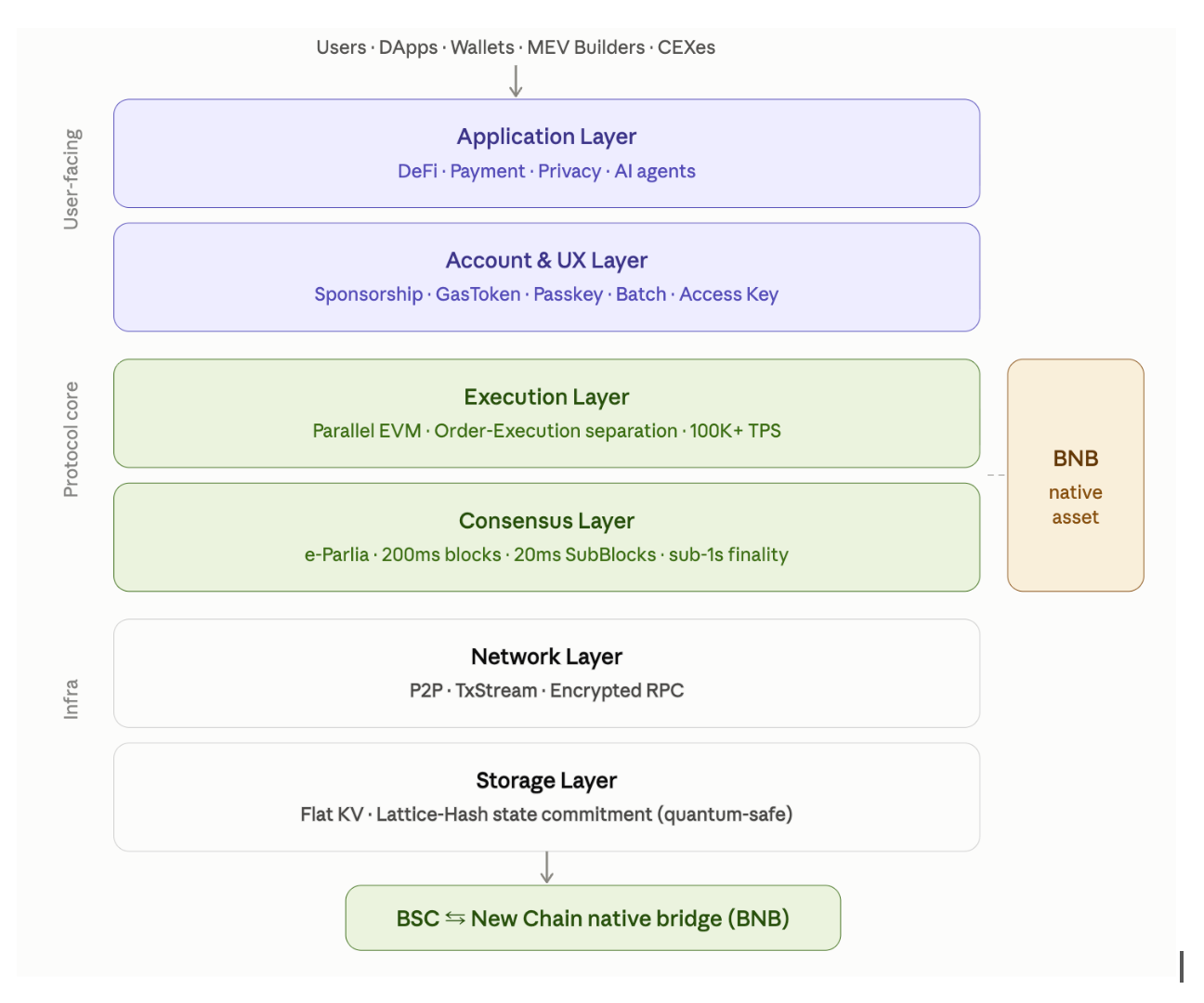
| Layer | What’s in it | Read more |
|---|---|---|
| Application | DeFi, payments, confidential finance, AI agents. An opt-in native shielded pool hides sender, recipient, and amount, and transparent transactions are unaffected | Privacy |
| Account & UX | Gas sponsorship, passkey (WebAuthn/P256) signing, batched calls, and scoped access keys, all as a native transaction type (0x76). No bundler, no entry-point contract, and the sender need not hold BNB |
Account Abstraction |
| Execution | Parallel EVM, with ordering decoupled from execution: consensus liveness does not depend on execution throughput. Multi-Lane reserves gas capacity per transaction class, so latency-sensitive traffic can’t be crowded out | Async Execution · Multi-Lane |
| Consensus | Enhanced Parlia uses cross-block BLS votes to target transaction-order finality in under one second, at the target 200 ms block interval. SubBlocks can provide a preconfirmation in approximately 20 ms. Execution finality follows only after a later block records the result and itself finalizes. | Consensus · Pre-confirmation |
| Network | P2P block and sub-block gossip. Transactions are routed straight to the current and next proposer instead of a global mempool | JSON-RPC Endpoint |
| Storage | Flat key-value store under a cumulative lattice-hash (LtHash) commitment instead of a Merkle-Patricia trie | State DB |
| Governance | Token-weighted (govBNB) proposal / vote / timelock control over protocol parameters, including the Multi-Lane quotas | Governance |
Role of BNB
BNB is the native asset of New L1, and no new token is issued. It is bridged from BSC and pays for gas, through a native BSC ↔ New L1 bridge that is still in development. Staking it with StakeHub mints govBNB 1:1, a non-transferable voting ledger that carries governance weight once it is delegated.
What This Means for Developers
Existing Solidity contracts and standard wallet flows run unchanged. Contracts, opcodes, and EVM behave exactly as on any other EVM chain, since execution builds on reth and revm. Four things around it changed:
- You pay for your declared gas limit, not gas used. Block space is sold by declared gas before execution runs (details).
- There is no global mempool. Transactions go directly to the current and next block producer, which is part of what makes pre-confirmation and Multi-Lane packing possible.
eth_getProofis unsupported, and so are EIP-4844 and EIP-7702 transactions. JSON-RPC Endpoint lists every difference in the RPC surface.- New features are additive. Account abstraction, pre-confirmation, Multi-Lane, and the shielded pool run alongside standard transactions, and none of them change how an existing contract behaves.
Start with Migrating from BSC if you already ship on BSC, or the Quick Guide if you don’t.
Network Parameters
| Parameter | Value |
|---|---|
| Block interval | 200 ms |
| Finality | sub-second (BLS fast finality) |
| Pre-confirmation | ~20 ms (sub-block) |
| Turn length (blocks per validator, per rotation) | 16 |
| Consensus | enhanced-Parlia |
| Gas asset | BNB (bridged from BSC) |
Current Status
New L1 runs today as a multi-validator devnet with real block production and end-to-end finality. Public testnet and mainnet are still ahead, and each feature page calls out what’s shipped versus still in progress.
Every interface in this manual has been exercised against a devnet built from source: the eth_*/newl1_* RPC surface, the full governance lifecycle, account-abstraction key management and the 0x76 envelope, and the complete shielded-pool flow. The only corrections that came out of it were minor response shapes, already reflected here. The client has moved on since, so the JSON-RPC Endpoint page is kept current against client source, and its newer methods are documented from the implementation rather than from a live call.